The big American banks spent ten years preparing for the wrong war.
They fought crypto — loudly, expensively, and mostly successfully. Jamie Dimon called bitcoin a fraud in 2017 and a pet rock in 2023 and told the Senate that if he were the government, he'd close it all down. Crypto companies spent years fighting to keep bank accounts open. The lobbying machine that once kept the coiners outside the perimeter now works full-time on strangling stablecoin yield in the crib. The threat model never changed: a casino full of speculators, safely walled off from real money.
Then, on the last day of June, the actual attack arrived — and there wasn't a coiner in sight. The consortium behind Open USD is the establishment itself: Stripe, American Express, BlackRock, Google, Shopify — and, above all, Visa and Mastercard, companies the banks built, owned, and spun off within living memory, now helping to construct the rail designed to route around their former parents. The networks hedged. JPMorgan, Bank of America, Citi, and Wells Fargo did not — and, as we'll see, could not.
The market picked its own wrong target, hammering Circle 17.5% on the day. But Circle lost a stock price. The banks are losing the perimeter. The defection — not the coin, not the 140 logos — is the event. Everything else is detail.
140 Logos, Four Absences
Strictly speaking, nothing launched. Open Standard — a newly formed independent company, run on an interim basis by Zach Abrams, co-founder of Bridge, the stablecoin infrastructure firm Stripe bought for $1.1 billion — announced a stablecoin called Open USD, ticker OUSD, to go live "later this year." The issuing entity was not disclosed. The reserve custodian was not disclosed. The blockchain was not disclosed, though the most-corroborated reporting points to Solana at launch with Tempo, the Stripe-incubated payments chain, to follow. For an announcement that erased billions of dollars of market value before lunch, it was remarkably light on nouns.
What it was heavy on was names. More than 140 founding partners: Stripe, Visa, Mastercard, American Express, Discover, Adyen, Klarna on the payments side; BlackRock, BNY, Standard Chartered, U.S. Bank, BBVA, DBS, Mizuho and some thirty other banks in finance; Google, Shopify, IBM, Samsung, Mercado Libre in tech; Coinbase, Ripple, OKX, Crypto.com, MetaMask, Solana, Base in crypto. And two mechanics that matter more than any logo: mint and redeem are free, with no volume caps — and the partners receive all of the earnings on the reserves, less a small management fee retained by Open Standard.
The consortium's product is not a coin. It is a machine for redistributing the yield on idle dollars away from whoever issues them and toward whoever distributes them.
Now read the membership list for who is missing. Circle and Tether, obviously — you don't invite the incumbents to their own repricing. But look harder: JPMorgan is not there. Bank of America is not there. Citi is not there. Wells Fargo is not there. Roughly thirty banks joined a consortium built around dollar balances, and not one of them is a big-four American retail deposit franchise. The banks inside — BNY, Standard Chartered, BBVA, DBS — are custody and settlement institutions. The banks whose business model is deposits plus interchange are all on the outside.
That split is not an accident. It is the whole architecture of what happens next.
The Margin Was Already Dead
Start with the victim the market chose, because the Circle story answers itself once you look at the numbers — and the answer is that OUSD didn't break Circle's model. The market had been breaking it for two years. OUSD just printed the memo.
Circle's 2025 annual report shows $2.75 billion in revenue and reserve income — and $1.66 billion of it paid straight back out as distribution costs, the bulk to Coinbase, which under the two companies' collaboration agreement keeps 100% of the reserve income on USDC held on its platform and half of the income on USDC held everywhere else. Revenue after distribution: $1.08 billion. Net result for the year: a $70 million loss. And the pressure was compounding well before June 30. Binance extracted a $60 million upfront payment plus ongoing incentives in December 2024. In May of this year, Hyperliquid — a single exchange — negotiated up to 90% of the reserve income on its roughly $5 billion of USDC. The direction of travel was unmistakable: the yield on the float belongs to whoever controls the balances, and the issuer keeps a service fee. OUSD's zero-fee, yield-to-partners design is not an innovation. It is the market-clearing price of distribution, stated in public.
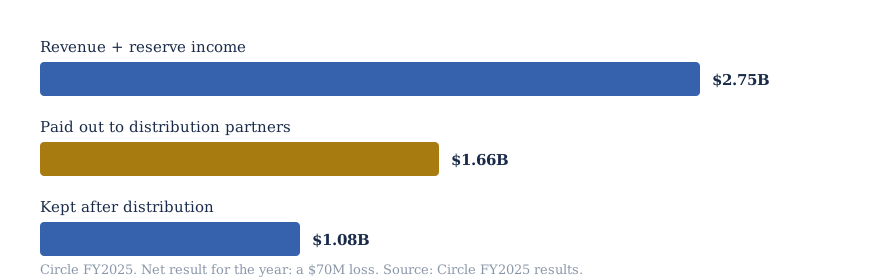
The issuer already works for its distributors. Circle FY2025: of $2.75B in revenue and reserve income, $1.66B went out to distribution partners — Coinbase foremost.
Which is also why the death-knell framing overshoots. The one live experiment in consortium stablecoins is Paxos's Global Dollar, launched in November 2024 on the identical pitch — shared reserve economics, "up to 100% of returns" to partners — with more than 130 members including, since June 2025, Mastercard itself. Eighteen months later USDG's supply is roughly $2.5 to $2.8 billion. USDC's is about $75 billion. The consortium model has been tried at scale, with marquee partners, and has so far bootstrapped about three percent of the incumbent's float. Jeremy Allaire's rebuttal the morning after — that the track record of consortiums reaching scale is "absolutely dismal," and that Circle itself ran the experiment with Centre and abandoned it — is self-interested and also, on the base rate, simply true. Most consortiums fail. This one has better distribution than any before it, which is a real difference; it also has 140 members with competing incentives, which is the same disease that killed the others.
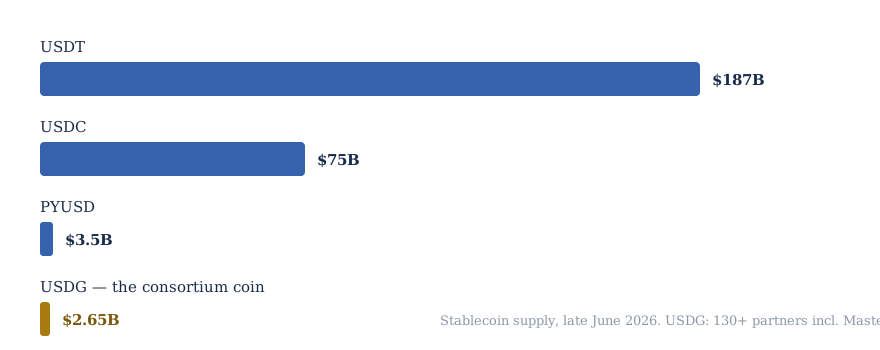
The consortium base rate. USDG — the direct template for OUSD — has bootstrapped ~3% of USDC's float in 18 months.
So hold both thoughts: Circle's margin structure was already repricing toward zero, with or without OUSD, and Circle's moat — order-book liquidity, hundreds of integrations, a licensing stack assembled over a decade — remains genuinely hard to replicate. The stock repriced a business model, not a bankruptcy. Circle's fight is about execution now, and it is at least a fair fight.
The banks' problem is not a fair fight. To see it, stop watching the coin and follow the fees.
The $111 Billion Nobody Mentions
Here is what actually happens, economically, when a card is swiped in America. The merchant pays an average of 2.35% on a credit transaction (Nilson, 2024). Of that fee, roughly three-quarters to 85% is interchange — and interchange does not go to Visa or Mastercard. It goes to the bank that issued the card. The networks themselves collect assessment fees of roughly 0.13 to 0.14% — thirteen or fourteen basis points for running the switch. On a hundred-dollar purchase generating about two dollars in fees, something like $1.75 goes to the issuing bank and about eighteen cents to the network.
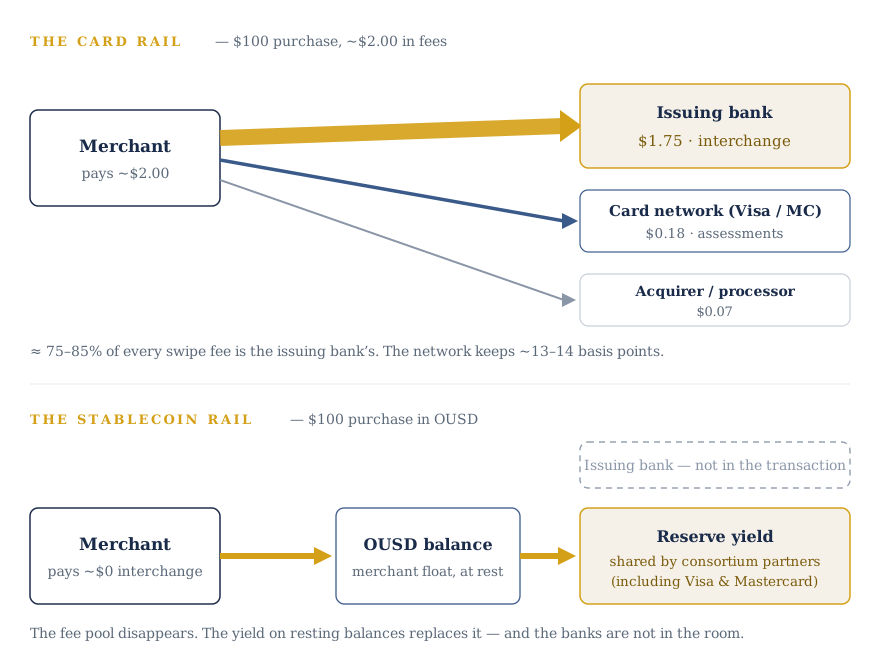
Who the swipe fee actually feeds — and who the stablecoin rail actually starves. Illustrative $100 credit purchase; splits per Nilson 2024 and published network assessment schedules.
Scale that up. U.S. merchants paid $187 billion in card processing fees in 2024, per the Nilson Report — $148.5 billion of it in credit-card swipe fees, of which $111 billion was Visa and Mastercard credit interchange. That $111 billion is bank revenue. The networks' cut of the system is real money, but it is an order of magnitude smaller than the pool the issuers collect.
Now run a stablecoin rail through that arithmetic. A merchant who accepts OUSD through Stripe pays no interchange, because there is no issuing bank in the transaction. Every dollar of card volume that migrates destroys bank interchange at roughly ten times the rate it destroys network assessments. A payment revolution that is routinely described as a threat to "the card networks" is, dollar for dollar, a threat to the banks behind the card networks — the networks were always the thin layer; the banks were always the fat one.
Which makes the consortium's membership list read very differently. Visa and Mastercard did not join a stablecoin because they were converted to crypto. They joined because they can count.
Visa Can Count
Consider the counterfactual the networks were actually facing. Stripe bought Bridge. Stripe incubated a payments blockchain. Stripe reportedly intends to make OUSD the default stablecoin across its platform. This rail was getting built with them or without them — and without them means the networks' thirteen basis points on displaced volume go to zero, full stop.
Joining changes the trade entirely. Inside the consortium, the networks swap a toll on transactions for a share of the yield on balances — reserve income on short-term Treasuries, distributed to partners under a formula the consortium has not disclosed. Whether that nets out above their lost assessments on any given dollar of displaced volume depends on how much float builds and how the split works, and honesty requires saying so. But the strategic conversion is unambiguous: Visa and Mastercard have spent fifty years as toll collectors with no balance-sheet economics whatsoever — they never held the deposit, never earned the float, never touched the credit. Membership in OUSD gives the networks their first-ever claim on money at rest. They converted certain disintermediation into participation in whatever replaces them.
That is what a hedge is. And it is exactly the move that was not available to the issuing banks, because the thing being redistributed — float income on idle dollars — is not a side business for a retail bank. It is the business. A bank cannot join a consortium whose premise is that deposit economics belong to distributors without conceding the premise. So the banks stayed out, and the networks — their former subsidiaries; Visa was a bank-owned association until its 2008 IPO, Mastercard until 2006 — walked across the line.
The defection is the story. Not the coin.
Float Is the Product
There is a catch in the consortium's design, and it is worth stating plainly because it is both OUSD's hardest problem and the banks' clearest warning.
Stablecoin revenue does not come from payment volume. It comes from float — balances that sit. And the two markets for dollar tokens could not be more different on this axis. Tether's $187 billion rests in trading accounts, exchange balances, and emerging-market savings; it sits still and compounds, which is why Tether is one of the most profitable companies per employee on earth. Payments float, by contrast, is transient: a merchant who accepts a stablecoin at noon and sweeps to fiat at five generates enormous volume and nearly zero resting balance. Visa has settled in USDC since 2023, and that pipeline runs at an annualized rate of only a few billion dollars — plumbing, not treasure.
OUSD, notably, is not built to fight for the trading market. Its crypto partners look like on/off-ramp infrastructure and future optionality around tokenized assets, not a commitment to out-bid Tether for the order book — a fight that would be ruinous and that nothing in the announcement suggests the consortium wants. The target is merchants and businesses: a different customer, a different go-to-market, and a much larger greenfield. This is also why the banks' crypto-shaped threat model failed them: they were watching the casino, and the consortium is not building a casino. It is building a checking account.
Because a payments-first stablecoin only earns its reserve yield if merchants can be persuaded to hold it — to keep working capital in OUSD rather than sweeping to a bank account every afternoon. The entire economic engine of the consortium reduces to one question: what can you offer a business for leaving its dollars at rest on your rail instead of in its bank?
The natural answer — pay them — is precisely the thing Congress just made complicated. And that is where this stops being a payments story and becomes a banking story.
The Banks Are Guarding the Wrong Door
The GENIUS Act, signed in July 2025, prohibits a permitted stablecoin issuer from paying holders "any form of interest or yield" for holding the coin. On its face the ban stops at the issuer — it does not name distribution partners, and Congress considered and declined to extend it. The OCC's proposed implementing rules, published in March, try to close the gap by economic substance: balance-based rewards, rebates, and loyalty tokens count as yield, and payments routed from an issuer through affiliates or revenue-sharing partners to holders are presumptively evasion. Final rules are due in mid-July. As this essay is written, whether an OUSD partner can legally pay a merchant for holding OUSD balances is an open question with a two-week fuse.
The banks understand exactly what is at stake, which is why closing the "yield loophole" has become their signature lobbying campaign — the Bank Policy Institute, the American Bankers Association, more than three thousand community bankers petitioning the Senate, and Jamie Dimon in May, on the record, at his bluntest: "The banks will not accept it." The number underneath the fury comes from the Treasury's own borrowing advisory committee, which estimated in April 2025 that stablecoins — especially yield-bearing ones — could pull as much as $6.6 trillion out of bank deposits. Brian Moynihan put the figure at $6 trillion and connected it to the thing deposits actually fund: lending.
But notice the shape of the campaign. It is the same war the banks have fought since 2017, with the same map: aim at the issuer, choke the coin, treat the whole category as a crypto problem to be regulated back into its box. The map has not been updated for a battlefield where the counterparty is Visa.
Suppose the banks win completely — suppose balance-based yield dies in the final rule. The consortium's members still keep the reserve income; the ban constrains paying yield down, not earning it. And the pass-through has a second channel that no stablecoin rule touches: rewards for spending. Transaction-based rewards — points funded out of a fee stream and paid when money moves — are not a loophole; they are the credit-card business model, and nobody alive runs that machine better than Visa and Mastercard. The networks spent five decades building rewards economies funded by interchange. Nothing prevents them from rebuilding the same machine funded by reserve yield, routed through the one channel the banking lobby cannot close without outlawing its own product.
The banks are fighting to block yield on holding. The networks already know how to pay it on spending. That asymmetry is worth more than every logo in the press release.
Two Clocks
None of this caught the banks entirely sleeping, and the honest version of this argument has to say so. Three weeks before OUSD's reveal, The Clearing House announced a seventeen-bank tokenized-deposit settlement network — JPMorgan, Bank of America, Citi, Wells Fargo and the rest of the top table — targeting the first half of 2027. A week after that, Early Warning Services, the bank-owned operator of Zelle, unveiled ZelleUSD for cross-border payments, targeting late 2026. JPMorgan's deposit token has been live on a public blockchain for institutional clients since last year. Fidelity — an asset manager, not a deposit-funded lender, which is precisely why it could move — has been issuing its own stablecoin through an OCC-chartered trust bank since February. The incumbents saw the technology coming; what they misjudged was who would be holding it.
Because look at the two clocks. OUSD intends to ship this year, into Stripe's merchant base, with Shopify and Adyen and Klarna already at the table. The banks' flagship response arrives in 2027, and it is not even the same product: tokenized deposits are bank liabilities that live inside the banking perimeter — permissioned, KYC-bound at every hop, and by design unable to circulate to a counterparty who doesn't bank with a member. That perimeter is the point, from the banks' perspective; it is also the limitation. As The $100 Trillion Secret argued about post-trade, incumbents rebuild new rails in their own image — and the image here is a walled garden racing an open network to sign up the world's merchants, with a one-to-two-year head start conceded at the gun.
The banks' truest weapon was never their own token. It is the rulebook — the yield fight, the charter gate, the state-by-state licensing gauntlet that OUSD's undisclosed issuer has not even publicly begun. That weapon is real. It has also never once stopped a repricing; it only decides who collects the toll during the transition.
The Barbell, Again
Readers of this series will recognize the shape, because it is the same shape every time. Three Doors One Hallway traced it in distribution: the front-of-trade captured by whoever owns the customer. The $100 Trillion Secret traced it in the plumbing: post-trade re-integrated by the incumbents who own the ledger. This is the money layer, and the barbell is identical — distribution and inventory fatten at the edges; the middle thins.
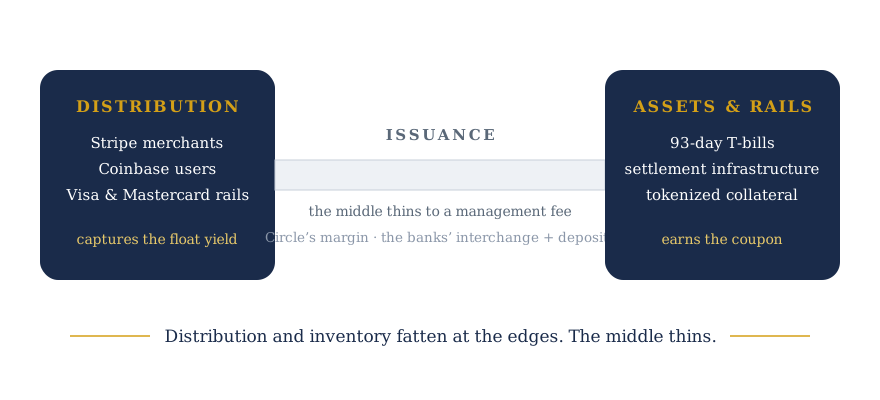
The money-layer barbell. The same structural dynamic this series has traced through distribution, post-trade, and demand — now applied to the dollar itself.
Stablecoin issuance was briefly the fattest middle in finance: take deposits, hold Treasuries, keep five percent, share nothing. That margin is going where all unearned intermediation margins go. At one edge, distribution — Stripe's merchants, Coinbase's users, the networks' rails — now collects the float income, because it can. At the other edge, the assets themselves earn the yield. What remains in the middle is a management fee, which is why the future of "issuing a dollar" looks less like a business than a utility — and why the value, as ever, migrates to what gets built on top of it.
Circle lives in that middle and gets to fight its way out with real assets: liquidity, licenses, a decade of integrations. The consortium's middle is thin by design — Open Standard keeps only the fee and was built that way on purpose. The American retail bank is the largest middle in the world: $111 billion of interchange on one side, trillions of zero-yield deposits on the other, both premised on the dollar having no better place to rest. OUSD does not have to succeed for that premise to die. Something like it only has to succeed once.
The market spent June 30 debating whether a consortium can beat Circle, and the base rate says probably not — consortiums break, liquidity is slow, and the incumbent has a decade's head start. All true, and all beside the point. Watch what the sophisticated money did, not what the headline said. BlackRock joined. Coinbase joined, two months before its Circle deal comes up for renewal. And the two companies that have watched every dollar of American commerce cross their switches for fifty years — companies the banks built, owned, and spun off — looked at the rail designed to route around them and bought in.
For a decade the banks kept their guns trained on the casino, and the casino never mattered. The technology walked out of it years ago, put on a suit, and got hired by Stripe. The thick layer — the interchange, the deposits, the whole quiet machinery of money at rest — is now defended by a rulebook written for a different enemy and a ship date two years out.
Circle lost a stock price. The banks are losing the reason deposits sit still — and they never saw the defector coming, because the defector was family.