By Daniel Kim · Eight Pine Labs
With research support from Tophash Digital
Robinhood spent most of a year telling investors it would tokenize equities. On July 1 it shipped the chain to do that, an Arbitrum Orbit rollup pitched around stocks and real-world assets, and within nine days the decentralized exchange volume running across it had climbed from roughly $200,000 to more than $500 million.
Stocks accounted for almost none of it.
By late July, memecoins were doing something in the range of $4.68 billion in weekly DEX volume on Robinhood Chain. The real-world assets the thing was designed to host sat at $13.2 million. A cat-themed token called CASHCAT ran up 2,158% in a week to a $156 million market cap. The chain has cleared 3.6 million transactions inside a single day and $838 million of DEX volume over 24 hours, against something close to 800,000 lifetime active addresses.
I want to set the memecoins aside and stay on the nine days, because the speed is the finding.
In Three Doors One Hallway, published in March, Christine Sandler and I argued that the three camps in financial services had stopped competing over technology and started competing over who owns the customer. We tracked $37 billion of 2025 crypto M&A across more than 265 deals and pointed out that the acquirers were buying user bases where they could have bought intellectual property. Coinbase paid $2.9 billion for Deribit and got 600,000 institutional derivatives traders. Kraken paid $1.5 billion for NinjaTrader and got a CFTC license plus US futures distribution. The piece closed on a claim I would write differently today:
The rails are a commodity. The door is the asset.
Five months of evidence says the second half of that held up and the first half named the wrong layer. Nobody holding a good door is renting rails from a neutral third party any more. Robinhood built its own, then charged the perpetuals venue Lighter half its revenue for the right to stand behind the app icon.
The two halves connect, and the connection is what the March essay missed. A door-owner gets to treat execution rails as cheap because somebody else discovered them first, at their own expense, in public. Crypto has spent a decade working as the research and development arm of financial services, and the arrangement is finally legible enough to describe. Discovering a product takes somewhere that launching it needs nobody's approval. Scaling one takes an account base, which costs a decade and a license to assemble, and nobody who owns one of those is willing to risk it on an idea with no demand curve attached. So the discovering and the scaling happen inside different companies, the value gets created in one place and collected in another, and whoever did the discovering has almost no way to charge for it.
The Function Nobody Designed
Britain's Financial Conduct Authority runs a regulatory sandbox, where a regulator grants a few licensed firms a temporary exemption to test a product on a capped number of consenting customers under supervision. Crypto has been running the same function without the permission, open to anyone with a wallet, on real money, at global scale, with nobody supervising and no ceiling on losses. It produces better data, because the money is live and no sponsoring institution gets to decide whether it likes the answer.
What comes out the other end is a demand curve. A product with an observable P&L and a known failure mode, which is worth far more to whoever holds the accounts than any prototype. Every major product in this cycle arrived through that pipe.
Perpetual futures were shipped by BitMEX in 2016, because no regulated futures exchange on earth could list a contract with no expiry and 100x leverage. Ten years of on-chain refinement later, Hyperliquid has cleared a billion dollars of cumulative protocol revenue on the design and holds around 70% of decentralized perp volume, Kalshi lists zero-fee Bitcoin perps as a registered exchange, and Robinhood pipes Lighter's book into 28.4 million accounts.
Stablecoins started with Tether in 2014 and USDC in 2018. Raw settlement volume ran $27.6 trillion in 2024 and is tracking past $40 trillion for 2026, though the honest number is the organic one, somewhere between $9 trillion and $11 trillion annualized once you strip out bot traffic and internal transfers. Standard Chartered had on-chain settlement growing at roughly 55% year over year as of March. The product is now issued by JPMorgan on Base, by Stripe through Bridge, by PayPal as a white-label service for any developer who wants one, by a ten-bank consortium building G7-currency versions, and by nine European banks doing the euro.
Yield on idle cash was proven by DeFi money markets, which established that a retail user will hold a dollar that pays them something. BlackRock and Franklin Templeton now sell it as tokenized Treasuries to institutions who would never have touched the version that proved it. BUIDL alone holds $2.6 billion, and the tokenized Treasury market has gone from $721 million to around $16 billion since that fund launched in March 2024.
Token launches were proven by pump.fun, which established that retail will trade a token minutes after its creation and pay for the privilege. Robinhood Chain matched Solana's flagship launchpad on weekly volume nine days after opening, with memecoins driving 79.2% of its DEX activity.
Each of those cycles took somewhere between one and ten years, and the pattern did not break once. Something launches where it needs no approval, either finds its users or dies quietly, and the survivors become legible enough that an institution holding the accounts can collect them without having carried any of the risk that produced them.
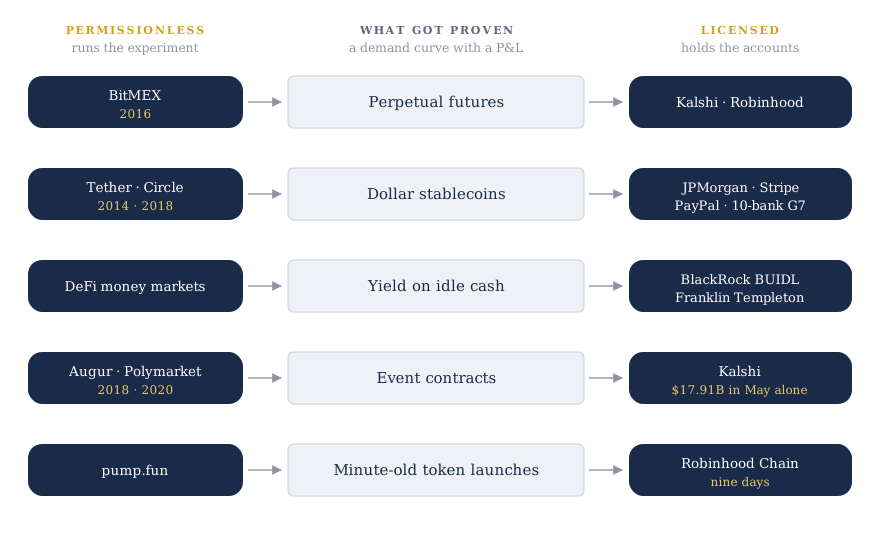
Ten years, five products, one direction of travel.
I made a version of this argument in The $100 Trillion Secret without generalizing it. That piece said tokenization is an incumbent post-trade re-integration trade rather than a crypto-native disruption, and that the institutions which built the settlement bug would own and price the fix. The same mechanism was operating there. Crypto proved atomic settlement worked and made the demand undeniable, and DTCC and BlackRock are the ones monetizing it.
The cost of running the sandbox falls entirely on the crypto-native side. They fund the failures, absorb the enforcement actions, spend years being described as a scam, and hand over a working product at the exact moment it becomes safe to own.
Kalshi Never Had to Run Augur's Experiment
In March we called prediction markets the fourth door nobody expected, then talked ourselves partway out of it. Coinbase had bought The Clearing Company for prediction market infrastructure, Hyperliquid had announced HIP-4 to put outcome contracts alongside its perps, and we concluded that prediction markets had stopped being a separate migration and become a feature every multi-asset platform would want on the menu. Ammunition for somebody else's war.
Four months of prints have complicated that.
Combined trading volume across Polymarket, Polymarket US, and Kalshi hit $50.6 billion in July, a record. June ran $44.8 billion on the back of the World Cup, which opened on June 11, with parlays accounting for close to half of Kalshi's volume. Kalshi closed May at $17.91 billion of notional volume, its ninth consecutive monthly record. Then it launched perpetual futures on crypto, with Bitcoin going live on June 3 at zero fees and Ethereum and XRP following, and Polymarket pushed its own perps product out specifically to land ahead of Kalshi's launch.
The two platforms have stopped moving together, which the aggregate number hides. Kalshi has been compounding monthly records on sports and parlay volume. Polymarket posted $7.08 billion in May, down 21% from its March peak. The record July print is a real number and a substantially Kalshi-and-sports number.
Sit with that for a second, because it is the cleanest specimen in this essay. Augur launched a decentralized prediction market in 2018 and went nowhere. Polymarket ran the experiment again on USDC and Polygon, without a license, and proved that hundreds of thousands of people would put real money on outcome contracts. Kalshi took the validated demand curve into a CFTC-registered exchange and now clears more volume in a month than Polymarket does, having never run the experiment itself. It also picked up the regulatory legitimacy that Polymarket spent years fighting for, then used it to list the perp product that BitMEX invented and Hyperliquid refined.
Follow the direction of travel and the absorption runs both ways. Coinbase bought prediction market plumbing to bolt onto an exchange, and the event-contract venues answered by growing a derivatives book under their own brand. A regulated event-contract exchange with more than 10 million registered users, listing zero-fee Bitcoin perps, is competing with Hyperliquid and Binance whatever the CFTC filing calls it.
The Experiment Still Running
Tokenized real-world assets crossed $22 billion of assets under management by May 2026 on rwa.xyz's count, split roughly between $10 billion of Treasuries and $8 billion of private credit. The totals move around depending on whether you count represented and platform-locked assets, and the wider counts run to $31 billion. Maple, Centrifuge, Goldfinch, and Apollo's tokenized credit fund hold most of the credit side.
The structure underneath a lot of it works like this. An originator pools loans, places them into a special purpose vehicle, and a tokenization platform issues tokens representing slices of the pool. What the holder ends up owning is a claim against an SPV, sitting junior in a waterfall they have mostly not read, at a legal remove from any borrower they could ever pursue. High yield is the compensation for accepting that position, and high yield is the number that appears in the marketing.
The arrangement grows because it pays both sides something they want. A credit originator gets AUM through a distribution channel that did not exist five years ago, filled by buyers who never appear on a cap table and never sit on a credit committee. The buyer gets a rate unavailable anywhere in regulated fixed income. Nobody in that trade is being defrauded, and the position is still worse than it looks.
Altura is the specimen worth reading. A $39 million vault on HyperEVM processed $8.5 million of redemptions inside 24 hours in June 2026 and began an orderly wind-down. The trigger came from somewhere else entirely. Main Street's msUSD fell more than 70% after Accountable, the firm attesting to its solvency, terminated the service agreement and said Main Street could not meet its verification standards. Altura held no exposure to any of it and ran anyway, because the only thing a depositor needs in order to redeem first is a suspicion that other depositors are about to.
Then there is the detail that belongs on the inside cover of every tokenization pitch deck. Altura's final payout to vault holders is still outstanding, because a bank restricted the account holding more than £16.4 million earmarked for redemptions. The token settled atomically. The money sat in a bank, behaving the way money in a bank behaves.
The full forensics of that mechanism belong in their own piece, and I am writing one. For this essay the point is narrower. The experiment has not returned its verdict yet, and my expectation is a default large enough to be undeniable, followed by a fix authored by people who have run a loan book through an actual credit cycle, followed by rates that fall to something defensible. The sandbox will have established that a great many people will lend against collateral they cannot inspect, and the product will get rebuilt by institutions that price recourse properly and charge for doing it.
Tokenized equities ran the same experiment on a shorter clock, and the collection is already visible.
Four issuers anchor the category. Backed runs xStocks for non-US retail, Dinari runs dShares for US accredited investors, Kraken distributes xStocks through the Backed partnership, and Robinhood issues its own wrapper to EU users. Robinhood Chain's tokenized stocks are structured as debt securities, so holders carry no shareholder rights at all, which is the credit product's tell wearing different clothes. Data integrity has been rough. Across 21 mismatched tokens, reported supply ran roughly 64,000 tokens above the real figure, a 56% discrepancy, with NAV erosion on high-yield ETFs explaining about 90% of the gap.
The deepest problem is the one the product was invented to solve. Underlying shares trade during US market hours, so when the offchain market closes the spread widens and Robinhood or its affiliated market makers carry the inventory risk of quoting something nobody can hedge. The 24/7 equity token turns out to be 24/7 in the wrapper, sitting on a market that is shut.
It worked anyway, in the way that counts. It established that people want to trade equities at two in the morning, and the licensed venues moved. The SEC approved NYSE Arca's shift to 22-hour trading in February 2025, then Nasdaq's 23-hour, five-day proposal in April 2026, with a day session running 4am to 8pm ET and a night session from 9pm to 4am. Both exchanges are targeting a late 2026 launch.
Look at what the missing hour is for. Nasdaq pauses from 8pm to 9pm to run maintenance and process the dividends, splits, and other corporate actions pending for the next trading day. Neither exchange can launch anything until DTCC extends its operations to cover the new windows, which it targeted for June 2026, and the SEC has separately signed off on the NSCC's plans for 24x5 clearing. The permissionless version reached 24/7/365 years ago with real-time settlement. The licensed version reached 23 hours across five days, and the gap between those two numbers is precisely the width of the post-trade plumbing that The $100 Trillion Secret spent three thousand words describing.
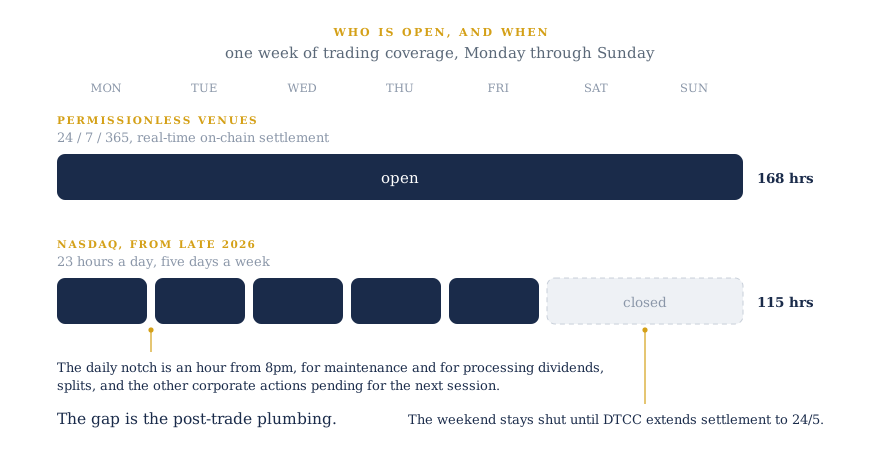
Nasdaq's 23/5 approval landed in April 2026. Both exchanges are targeting a late 2026 launch.
The Rails Were Supposed to Be Cheap
That is where the products come from. What follows is what it costs to collect one.
Robinhood held the strongest hand in the March framing, and the Q2 numbers it reported on July 29 are stronger still. A record 28.4 million funded customers, up 940,000 in a single quarter. Total platform assets of $369 billion, up 32% year over year. Record quarterly revenue of $1.31 billion. Gold subscribers at a record 4.8 million, up 39%. Net deposits of $21.7 billion in the quarter, running at a 28% annualized growth rate, with average assets per funded customer climbing from $10,500 to $13,000. The company had already bought Bitstamp for $200 million and WonderFi for $180 million to pick up more than 50 global crypto licenses.
Given that position, the cheap move was to keep buying access. List the tokens, route the flow to Solana or Base or wherever liquidity already sat, collect a spread, and let somebody else carry the cost of running a chain. Plenty of brokerages do exactly this through Zerohash and similar plumbing, and the economics work fine.
Robinhood built its own L2 instead. What that buys is control over the surface where tokens get created, which now sits inside the same perimeter as the brokerage account, the retirement account, the debit card, and the app icon. Sequencer revenue stays in house as well, and listing policy turns into a product decision instead of a negotiation with somebody else's foundation.
Nine days from $200,000 to half a billion is what happens when a launch venue opens with tens of millions of pre-verified accounts already sitting next to it. There was no user acquisition problem to solve. The users were downstream of a login they already had.
In March we had distribution sitting at the front of the trade collecting a toll. It has since walked upstream and started building the thing it used to pay other people for.
Lighter Rented the Door
Three Doors used Lighter to settle an argument about moats. In late 2025 it briefly passed Hyperliquid in 30-day perp volume while charging zero fees and running one of the most aggressive incentive campaigns DeFi had seen. Then the $LIT airdrop landed, $250 million walked out in 24 hours, volume collapsed, and capital went back to Hyperliquid despite higher fees. We took that as proof that liquidity depth and execution quality protect an exchange the way they have always protected exchanges, and that emissions cannot buy your way past them.
The revenue line bears that out with some force. Lighter earned close to $40 million in Q4 2025. In Q2 2026 it earned under $10 million. The technology did not change over that stretch. It still holds third place among decentralized perps venues with $1.3 billion of daily volume moving through it, and roughly three quarters of its revenue disappeared inside two quarters.
What it did about that is the story. Lighter went live inside Robinhood Chain on the July 1 mainnet, with margin posted from Robinhood Chain assets into Lighter's smart contracts, $USDG serving as both collateral and quote asset, and the whole trading experience wrapped inside Robinhood Wallet. Robinhood takes 50% of the revenue. Lighter committed $11 million of $LIT to the Robinhood community, with users earning points on perp trades and double points for trading through Robinhood. The token rose about 35% over the following week. Lighter's chief executive described the deal publicly as the product of twelve years of relationship building.
A venue that was earning $40 million a quarter on its own rails now hands half of what it makes to stand behind somebody else's login screen.
The geography sharpens it. The perps product is unavailable in the United States, the United Kingdom, Canada, Switzerland, the UAE, and Singapore. Robinhood's home market cannot touch the thing. What Lighter rented was the international remainder of the account base, and that remainder still cleared 50% from the party that built the matching engine.
Put the two Lighter episodes side by side. The airdrop taught us that emissions cannot manufacture liquidity, which is what we wrote in March and I stand by. The Robinhood integration says something about where liquidity does come from, and the answer sits well outside market microstructure. Whatever Lighter's binding constraint was, it lived on the acquisition side. The company spent eighteen months buying users in the most expensive input market in this business, then priced Robinhood's account base at half its revenue.
The Dollar Was Designed to Pay the Door
One detail in the Lighter integration deserves more attention than it has been getting. The collateral and quote asset is $USDG, which is neither USDC nor USDT.
USDG is issued by Paxos Digital Singapore and sits at the center of the Global Dollar Network, launched on November 1, 2024. The founding partners were Paxos, Robinhood, Kraken, Galaxy Digital, Anchorage Digital, Bullish, and Nuvei. The network has since gone live in the EU and pushed past 130 partners.
The design premise is what makes it interesting. USDG shares the income from its reserve assets with the platforms that drive adoption, so any exchange or wallet or fintech that integrates it earns a cut of the yield on the float. Paxos built the distribution toll into the instrument at issuance.
Now count what Robinhood earns on a single perp trade placed through its wallet. There is the interface itself, which brought the customer. There is the chain the trade settles on, where sequencer revenue accrues to Robinhood. There is 50% of Lighter's revenue on the trade. And there is a share of the reserve income on the USDG sitting as margin in the account, by virtue of Robinhood having been in the consortium since launch. Four layers of the same trade, on rails Robinhood either owns or co-owns, for a customer it acquired years ago selling commission-free equities.
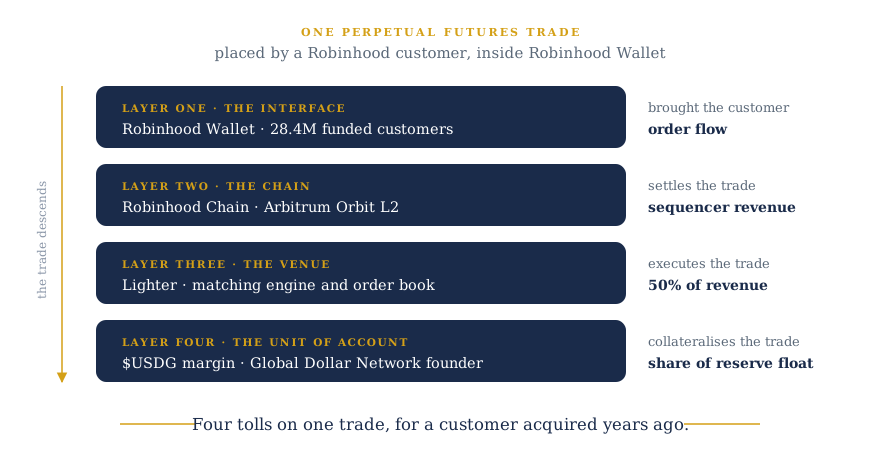
Robinhood's position on a single perpetual futures trade routed through its own wallet.
Compare that with how Circle got here. USDC's distribution economics were negotiated after the fact, and Circle now pays Coinbase a large share of its reserve income to keep USDC in front of Coinbase's users, which is a permanent constraint on Circle's margins and was disclosed as such in its filings. Every stablecoin issuer without a consumer app eventually signs some version of that deal. Paxos looked at the arrangement and shipped a token that starts from it, then invited in everyone else holding distribution and no stablecoin of their own.
This is the March claim written into a monetary instrument. When the unit of account pays a share of its float to whoever brings the users, the toll stops being a business development outcome that gets renegotiated at contract renewal. It lives in the mint. A consortium of 130-plus partners built around that premise is the clearest read available on what the industry now believes the scarce asset is.
Thirteen Business Lines
The four-layer stack is not a one-off structured around perps. It is how Robinhood now approaches every product the sandbox validates.
The Q2 release counted thirteen separate business lines running above $100 million, and the earnings beat was driven by record revenue from prediction markets. Hold that against the March essay, where we watched Coinbase buy The Clearing Company and concluded that event contracts had become a feature every multi-asset platform would want on the menu. Robinhood put it on the menu and it became one of the fastest revenue lines in the company.
The pattern generalizes without much effort. Someone permissionless establishes that a product has demand. Robinhood adds it as a line item, prices it against an account base that took fifteen years and a fintech bull market to assemble, and books it at whatever margin the four-layer position allows. Equities, options, crypto, retirement accounts, prediction markets, perps through Lighter, tokenized equities in the EU, and a chain underneath the whole thing.
Nothing in that sequence requires Robinhood to have invented anything. It requires Robinhood to notice, and to already own the relationship.
Stripe Is Hiring the Commons
Tempo has moved faster than the March piece anticipated. The Stripe and Paradigm chain raised $500 million at a $5 billion valuation, shipped mainnet in March, and by April had added Stripe, Visa, and Zodia Custody as its first external validators. In the same month it stood up an advisory unit to push stablecoin adoption among institutions.
The hiring is the part worth sitting with. Headcount went from about five people in August 2025 to somewhere between 40 and 50 by November. Look at who they got.
Dankrad Feist came from the Ethereum Foundation, where he worked on data availability, which is the research that lets public blockchains scale without going custodial. Liam Horne ran Optimism as chief executive. Dan Romero and Varun Srinivasan, the Farcaster co-founders, joined through the Neynar acquisition; Romero was a Coinbase executive before that. Lindsey Haswell arrived as head of legal from MoonPay, where she was chief legal and administrative officer. Rachel Busch left Circle to run communications.
Our March M&A table tracked companies buying companies. This is a different kind of transaction. Stripe is acquiring the specific individuals who built credibly neutral public infrastructure and installing them in a chain where Stripe and Visa validate the blocks. Ethereum's data availability roadmap and a social protocol whose entire pitch was that no company controlled it now both inform a payments network owned by a firm carrying a $159 billion valuation and a national trust bank charter in progress.
Stripe had the distribution long before any of this, with millions of merchant relationships and stablecoin volume up fourfold. The scarce input was people who have run permissionless infrastructure at scale, of whom there are maybe a few hundred on earth. I flagged something adjacent in the preface to Three Doors, when I told friends asking about career moves to go back to Web2 and look hard at TradFi, on the grounds that operators inside fintech were working on the largest capital formation event in a decade. The Tempo hire list is that argument turning up in the labor market sooner than I expected, running from the Ethereum Foundation and Optimism toward a chain with Visa as a validator.
What Thinned
The tempting version of the Robinhood Chain story is that it took Solana's users, and the data will not support that.
Solana holds something like 27 times Robinhood Chain's total value locked and millions more users. Volume is the one metric where Robinhood Chain looks competitive, and volume is the softest number on the board, easy to inflate with wash activity and low-float launches. Robinhood Chain matched Solana's flagship launchpad on weekly volume, which is a real result and a narrow one.
The category has been shrinking underneath all of it. Total memecoin market capitalization is down to roughly $30 billion, having shed more than $110 billion from the 2024 peak. Pump.fun revenue fell from $4.8 million a day in early 2025 to $800,000 by June 2026. Meme share of Solana DEX volume ran above 70% in December 2024, dropped below 10% by late 2025, and recovered to around 42% by late July 2026.
So the accurate version goes like this. Robinhood walked into a category that had already lost three quarters of its value, and inside nine days it led that category's most visible metric, because it arrived with 28 million accounts wired to the launch venue. Solana kept its developers and its liquidity. The marginal speculative dollar went to a competitor that never had to earn a single user.
That is the recursive pattern from the earlier essays, one layer down. Three Doors put the barbell on the front of the trade. Born Backwards put it on the demand side, where one person assembles a financial operating system out of modules pulled from all three bundles. This round puts it on the discovery process itself. Being first to a product that nobody has permission to sell pays, and owning the accounts you can sell a proven product into pays. The margin drains out of whoever ends up holding a validated product with no way to reach anybody.
The group worth watching hardest is the set of companies that spent a decade building rails and enterprise relationships without ever acquiring a consumer position. Ripple has been paying to get out of it, $1.25 billion for Hidden Road and $1 billion for GTreasury, both purchases of client relationships. Circle is in it too, dependent on Coinbase to distribute USDC while Stripe issues through Bridge, PayPal white-labels PYUSD to any developer who asks, and JPMorgan runs JPMD on Base. Their staff are also the ones turning up on the Tempo hire list.
What Survives Being Collected
The version of this argument that gets you fired is the one where crypto-native companies are all doomed to be somebody's unpaid research department. Tether is sitting on roughly $183 billion of USDT and settles that question, against about $72 billion of USDC at Circle. Between them they hold close to 90% of a stablecoin market that has run past $300 billion. Neither has been displaced by a bank consortium, and the banks have been trying since 2019.
So discovery does convert into a durable business, and the condition is where the network effects end up living. USDT's advantage sits inside the asset. It is the default quote currency on most of the world's exchanges, it is wired into tens of thousands of integrations, and a bank issuing a competing token gets none of that by minting one. Lighter's matching engine accrues nothing that survives being unplugged from a front end, which is why the deal it signed looks the way it does.
That gives a test worth applying to any crypto-native company you are underwriting. Ask whether the thing it discovered gathers network effects in the asset or in the interface. Stablecoins gather them in the asset. Liquidity depth on a derivatives venue gathers them in the asset, slowly, and Hyperliquid has spent two years proving it. Launchpads, wallets, front ends, and execution engines gather them in the interface, where a company with 28 million accounts will always be able to buy or rebuild the position.
Then there is the residual that cannot be collected at all, which is where the floor sits. Non-custodial wallets carried 68% of crypto transactions by the third quarter of 2025, roughly 59% of wallet users globally say they prefer holding their own keys, and non-custodial swap volume grew more than 340% year over year going into 2026. No licensed institution can absorb self-custody or permissionless listing, because absorbing either one costs the license that made absorption worth doing in the first place. Hyperliquid listing crude oil perps on a Saturday afternoon during a shooting war is not a product a registered exchange can copy at any price.
This is the honest answer to the question of what wedge is left. It is a real wedge, and it is narrow. It supports two or three companies at scale rather than an ecosystem of four hundred.
Three Things I Expect to Be Held To
Forecasts without a way to check them are entertainment, so here are three with markers attached.
The first is that the crypto-native share of global perpetual futures volume falls as US market-structure rules land. If the wedge is permissionlessness, then resolving the ambiguity resolves the advantage, and a CFTC-registered venue with a consumer app takes the flow. The way I find out I am wrong is if clarity arrives and the share holds, which would mean the moat was execution quality the whole time and I have overweighted the legal position.
The second is that revenue splits ratchet against infrastructure. Lighter took 50% in 2026. The next three comparable deals land closer to 30%, because the distributor's alternatives keep getting better and there are now four interchangeable venues willing to bid for the same shelf space. Three Doors said the rails are a commodity and named the wrong layer. Settlement rails are consolidating into consortiums that pay their members. Execution engines are the part turning into a commodity.
The third is that float overtakes fees. USDG exists because somebody worked out that reserve income is the durable revenue line and trading volume is the cyclical one. Within three years the largest revenue line at the consumer platforms in this essay is income on balances rather than transaction fees, and the competitive fight moves to whose stablecoin is the default balance in whose wallet. Robinhood's disclosed revenue mix is where that gets settled.
Who Pays for the Research
Every industry with a research function has to answer who funds it and who owns the output. Pharmaceutical companies patent theirs. Universities license theirs. Bell Labs ran on a monopoly rent large enough that giving discoveries away cost the parent nothing it noticed.
Crypto's version has no patent and no monopoly. The output goes public the moment it works, and the party best equipped to commercialize it is whoever already holds the customers, which is a consequence of the same permissionlessness that makes the discovery possible in the first place. That arrangement will not be renegotiated, because the thing you would have to give up to fix it is the thing that makes the sandbox work.
Two practical implications fall out of it. If you are building, the question that decides whether you keep what you find is whether the network effects accrue to the asset or to the screen. If you are allocating, the discovery premium is an option rather than a franchise, and it deserves to be priced like one.
Three Doors ended by promising a piece about the fourth participant, the one with no demographic, which routes around doors instead of walking through them. That piece is still owed, and the anchor has now arrived. Tempo shipped a payments protocol for AI agents in March and launched its mainnet with agent transactions supported at the base layer. Robinhood has Cortex reading markets and building indicators. The perps venue Robinhood just wired into 28.4 million accounts is API-native and always open, which describes something built for software at least as much as for people.
Lighter paid half its revenue for access to a human being with a login. Paxos wrote the same payment into the money itself. Robinhood spent a year assembling four layers of toll on a single trade, all of them resting on that identical assumption. Autonomous execution is being tested right now in the only environment that will settle a payment for a piece of software without a compliance review first, and if the pattern holds, somebody permissionless proves it works before a licensed institution collects it. What gets collected this time does not read a push notification and does not care which app icon it was routed through.
This piece continues Three Doors One Hallway: The Distribution Wars (March 2026), The $100 Trillion Secret: The True Story of Tokenization (May 2026), and The Great Migration (March 2026). Data sources: rwa.xyz, CoinDesk, CryptoBriefing, crypto.news, The Block, Messari State of Solana Q1 2026, ChainCatcher, Paxos, Fortune, DL News, SEC filings and SRO notices, Robinhood investor relations. Market data as of early August 2026.*